

Bài giảng Tiếng Anh Lớp 10 - Unit 4: Special education (Reading)
 34 trang
15/12/2025
710
34 trang
15/12/2025
710
Bạn đang xem 20 trang mẫu của tài liệu "Bài giảng Tiếng Anh Lớp 10 - Unit 4: Special education (Reading)", để tải tài liệu gốc về máy hãy click vào nút Download ở trên.
Tóm tắt nội dung tài liệu: Bài giảng Tiếng Anh Lớp 10 - Unit 4: Special education (Reading)
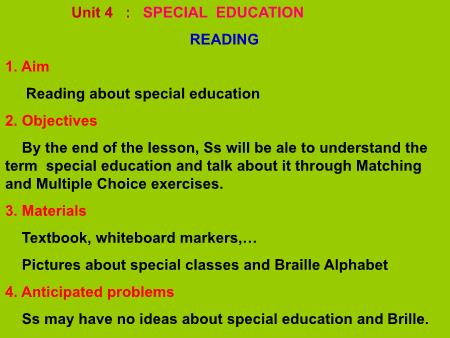
 Unit 4 : SPECIAL EDUCATION
	 READING
1. Aim
 Reading about special education
2. Objectives
 By the end of the lesson, Ss will be ale to understand the term special education and talk about it through Matching and Multiple Choice exercises.
3. Materials
 Textbook, whiteboard markers,
 Pictures about special classes and Braille Alphabet
4. Anticipated problems
 Ss may have no ideas about special education and Brille .
welcome!
UNIT 4: SPECIAL EDUCATION
CLASS 10
TEACHER IN CHARGE : TRAN NGOC HAI
DATE: 10/13/2006
CHECKING THE PREVIOUS LESSON
READING: SPECIAL EDUCATION
New Lesson
Educational Aim
Students understand some types of special education
SKILLS: READING
Special education for the disabled
TABLE OF CONTENT
 I. Presenting the lesson
II. Checking comprehension
 III. Consolidation
 IV. Game
Pre - reading
1. What do you call the people who can’t see?
2. What do you call the people who can’t hear?
3. What do you call the people who can’t speak?
4. Have you ever known any special schools for them?
 The blind
 The deaf
 The dumb or the mute
 Nguyen Dinh Chieu Special school for the blind
School for the dumb and the deaf at Binh Duong province
 Hoa Binh Youth Village for the mentally retarded at Go Vap
Look at the activities. Which ones are difficult for blind, deaf and mute children?
Activities
Deaf
Mute
Blind
Listen to teachers
Pronounce words
Go shopping
Communicate with friends
Phone friends
Look at blackboard
Guess his disability
This is Louis Braille, the great benefactor of human. It was he that invented the Braille Alphabet
BRAILLE
These dots represent the alphabet of a language for the blind – What’s the name of the language?
BRAILLE
By touching raised dots, the blind can read what they want
Hellen Keller (1880-1968)
She became blind and deaf – but she could read and write at the age of 6.
She graduated Colleges, gave lectures and traveled to many countries
A disabled sportsman
A DISABLED TEACHER
The paralyzed
The disabled can work in groups
WE
ARE
THE
WORLD
Look at the requirements. Are they necessary for teachers in teaching disabled children?
Requirement
Yes
No
Determination
Demonstration
Aid instruments
Opposition
Support
Impatient
Time
While - reading  Phrases or new words:
Disabled (a) Disability (n)
Dumb (a) Dumbness (n)
SIGN LANGUAGE FOR THE DUMB
Mentally retarded: less developed mentally than normal
 Time - consuming time - saving
 Demonstration (n) = show
 Opposition : the act of strongly disagreeing with sb / st oppose (v)
The words in A appear in the reading passage. Match them with their definitions in B
A
B
a. taking or needing a lot of time
b. An act of showing or explaining low how to do something
c. Unable to use a part of the body in the normal way
d. Slowly, over a long period of time
e. Less mentally developed than normal
1. Disabled
3. Time-consuming
5. Gradually
4. Demonstration
2. Mentally retarded
Read the passage again and complete the following sentences by the corresponding letter A, B, C or D
1. Thuy’s class is different from other classes because the children__ .
A. are from large families
A. interested in
B. are less mentally developed
C. love Maths very much
D. are disabled
2. At first the parents were ______ the idea of sending their children to the special class.
B. opposed to
C. satisfied with
D. worried about
3. It can be inferred from the second paragraph of the reading passage that there has been ______ .
A. a change in the parents’ attitude towards the class
B. a lot of protest from the parents against the class
C. a feeling of doubt in the teacher’s ability
D. a belief in the parents’ opposition
4. The writer describes how Thuy teaches the children to add and subtract in order to prove that _____ .
A. the children like Maths
A. humorous
B. the teacher is proud of her work
C. the teaching work takes time
D. adding and subtrating are important
5. The writer’s attitude towards Thuy’s work in the passage can be described as ______ .
B. angry
C. suspicious
D. admiring
Question s and answers
1. Does Ms Pham Thu Thuy enjoy her teaching?
2. How are the children in her class?
 yes
 They are disabled
3. Why did the parents oppose the idea of sending their children to the special class at first ?
 Because they thought their children couldn’t learn anything at all
4. In what way d id Ms Thuy teach the children how to add and substract?
 She raised both arms and opened up her fingers one by one until all ten stood up, she then closed the fingers one by one. She continued the demonstration until the children realised they had just learned how to add and subtract
 Post – reading : Fill each of the blanks of the summary below with a suitable word from the reading passage
Twenty-five (1) ___ __ ___ children have the chance of learning how to (2) _ _ __ and (3) __ ___ thanks to the (4) _________ ___ _ of a young teacher, Pham Thu Thuy.
Although her idea, at first, met with (5) _______ from the parents of the disabled children, more children attended her class later.
The teaching work in the special class is (6) ______ ____ _____. For example, in a (7) ____ lesson, the teacher has to use her (8) ____ and (9) _ ___ ____ to teach the children how to add and subtract. The children are now (10) _ _ ____ and happy
disabled
read
write
determination
opposition
time-consuming
maths
arms
fingers
proud
Guessing game
Homework and Assignment
blind
disabled
deaf
What would happen to the disabled children if a special class was not organized for them?
Why couldn’t the parents give their disabled children an education?
What should local charity society do to help the disabled children?
How can they do everything without seeing hearing or speaking?
Why did the parents oppose the idea of sending their children to the special class at first?
In what way did Thuy teach the children how to add and substract ?
Have you ever attended the schools for blind, deaf and mute children? How can the deaf and the mute overcome their difficulty?
Read the text and answer the following questions:
Thank You !
File đính kèm:
- bai_giang_tieng_anh_lop_10_unit_4_special_education_reading.ppt


